

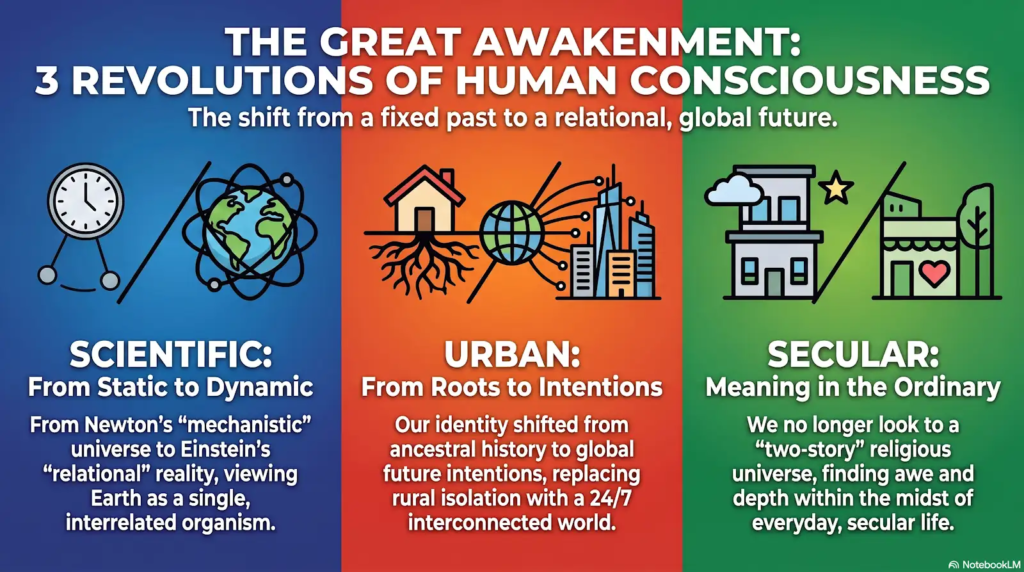
Common Sense—the scientific revolution
The Cultural Revolution was initiated early in the 20th Century when Albert Einstein published his two famous papers. The last great scientific paradigm shift was occasioned by Sir Isaac Newton’s analysis of the universe as mechanistic, following strict laws and unchanging. Einstein showed that we lived in a dynamic universe that was relational rather than static. Einstein proposed that what looks static is the result of powerful forces holding energy in relationships. Change the relationship and it all changes. Thus Energy is created from matter and vice versa. (E=MC2)
While dynamic and relational this led to seeing that we live in a universe that is profoundly unified. The photo of the earth revealed spaceship earth in its entirety. We have come to realize that it is a vast complex, interrelated organism and that we are part of that organism rather than separate from and in control of it. Today we know that we live in a universe that is ever-changing and that nothing is eternally determined or predestined. We have come to know ourselves as bound neither by our past nor our present situation. We now know that we have the potential to become change-makers who need to research, predict and weigh-up the possibilities and consequences of our actions before making decisions. We know that our decisions, whatever they are, will affect both our immediate environment and all of this interrelated universe. You can take this journey visually in Eames’ video the power of ten video.
Common Style– the urban revolution
In the 19th Century people began to leave the rural and move to cities. In the 20th Century we all came to live in an urban world no matter where we lived. In this urban world we encountered the diversity of the world and experienced the opening of our world view to encompass the world on our doorstep. Our external space shrank but our internal space opened to all of creation. Today the internet, cell phones and social media have brought it all even closer. Today we struggle to ensure that our world view is inclusive of all that needs to be considered as we face major decisions.
We no longer live to the rhythms of nature and the seasons. Day and night are interchangeable and life moves at a 24/7 pace. It is all interconnected, complex and hard to either fathom or keep up with. Reflection time in decision making is limited and there seems to be no let-up as one decision follows on the heels of another. In the rural world relationships and or caring were limited to those in our immediate surroundings. However, in the urban world we find ourselves aware of and in relationship to the globe. Neighbor caring for neighbor while still important is not adequate in this urban world. Care must become structured care—justice for all—must become our focus. We used to identify ourselves by talking about where we were from, who our ancestors were and what they did. Today we identify ourselves by sharing our intentions for the future. While the past is still significant we do not allow it to define or limit us. We understand ourselves as always becoming, a creation in progress as we move into the open future.
This fast-moving, deeply interconnected urban world we all live in is unrelenting in its demands upon us. We are challenged to find ways to stay healthy and to navigate this demanding world.
Common Mood– the secular revolution (Link to lecture)
Throughout history we encountered the ultimate mystery of existence by looking outward; such encounters were extra-ordinary and beyond the mundane. Today much that was unexplainable and mysterious has become knowledgeable and mundane. Today the mystery does not impinge our existence at the edge but rather at the center of existence.
The awe-filled encounter with the ultimate mystery always demands a response. For ages the response was to search for an eternal pattern or fixed moral code that we could follow. Today we know that we, ourselves, must create that pattern or moral code. We decide what is necessary and devise the code which guides us. In the past we struggled to appease the natural, hereditary and psychological powers that we believed controlled our lives. Today we know that we are defined by the relationships we find ourselves in and that we decide our response to them. We create our destiny. In the past the foundation of our decisions was always external. It might have been religious principles, society’s laws, tradition and customs, or other proven wisdom and authority. Today we know that the foundation is the authenticity of our own life experience. We struggle to know as fully as possible the reality we are living. We decide our answers in the most comprehensive context we can discern and then risk acting, taking responsibility for the consequences or our actions.
Theological revolution: The cultural revolution created globally a mindset that was unabashedly scientific, urban, and secular. This posed a challenge to theology since science did away with the two-story universe assumed by scripture and tradition; urbanity rendered obsolete the rural imagery used in earlier times; and secularity found awe and meaning in the midst of ordinary life rather than in a special religious realm. The function of religious practices is to make us aware of important features of ordinary life that we tend either to overlook or deny.
- Link to Bending History Section I: Joe’s Theology p3 Section II : the Religious Life p 113
- Stover, Nelson, Worldview Talks for Those Who Care (May 2022)