


HIGHLIGHTS
AI NOTEBOOK LM DIALOGUE with related INFOGRAPH and SLIDESHOW
BACKGROUND
NAME ORIGIN: Caño Negro means “black creek”, and is named after the dark waters of the creek which bounds it on three sides. The people are descendants of black slaves.
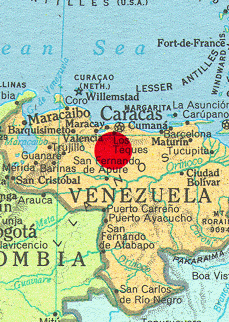
GEOGRAPHY: Caño Negro in northern Venezuela, in the state of Miranda, is located at the end of a dirt road three kilometers from the town of Tapipa. The village is in a valley of lush tropical forests. The average temperature is 28 degrees Celsius. There is a marked wet and dry season and limited fresh water supply in the dry season.
POPULATION: Caño Negro is a village of 250 people, 43 families.
CHALLENGES: The village is faced with a major struggle to break out of its isolation and traditional patterns and to develop social and economic self sufficiency.
HISTORY: This was traditionally a land of haciendas, raising cacao, first with the native Indian labor, then black slaves, and then sharecroppers. The village was founded in 1912, a collection of mud huts inhabited by liberated slaves. A law passed in 1948 made the sharecroppers independent farmers. An agricultural syndicated was formed in 1962 that somewhat stabilized the cacao situation. However, the traditional one-crop subsistence patterns of agriculture continued.
ACCOMPLISHMENTS
By 1980 the people of Cano Negro celebrated the following accomplishments:
- Village income doubled by increasing cacao land under cultivation, cacao processing and delivery.
- 3 new industries provide supplemental income.
- Community store saves each family about $200 per year.
- Acquisition of 3 vehicles and road leveling has improved transport.
- Construction of complete community public works has been done, including a community center, public sanitary facilities, new streets, sidewalks, chapel, plaza and sports fields.
- Community initiative is evident in private construction of 41 new homes, the first registered Civil Association in Barlovento, a Youth Commission, task and neighborhood groups and regular village events.
- Basic education has been upgraded from 1 to 4 primary teachers, residential school director, new preschool, and construction of a second primary school building.
- Cano Negro was the training base for continental leadership to launch five other Latin American projects and trained its own adults in numerous practical courses.
DOCUMENTS
- Priorship Training School, A Training Experiment, Cano Negro, March 4-22, 1983
- Barlovento and Cano Negro Multiplication Model, May 1982
- Cano Negro Report, and in Spanish, May 1980
- Cano Negro Progress Report, June 1979
- Cano Negro Resident Interviews, April 1979
- Cano Negro Economic Acceleration, January 1977-April 1979
- Cano Negro, 1978
- Cano Negro Quarterly Report, December 1978
- Cano Negro Progress – Letters, 1978
- Human Development Training School, April 7-Jun5, 1978 with Maneuvers
- Cano Negro Summary: Relationships and Budget, March 1978
- Cano Negro Report, March 1978
- Cano Negro: Doing the Stakes! January 1978
- Cano Negro Six Month Program Report, July 1977
- Three Month Program Report, July 10-September 30, 1977
- Cano Negro Report, July 1977
- Cano Negro Bulletin, July 1977
- Cano Negro Progress Report, March 20-July 9, 1977
- Cano Negro Implementation, Jan-March 1977
- Cano Negro HD Summary Report, January 1977
- Canon Negro HDP Consultation Summary Statement, 1977